
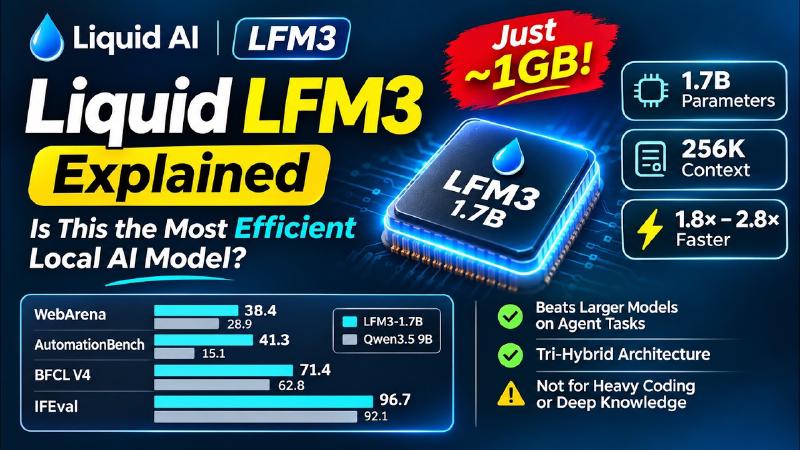
What if a 1 GB AI model could beat a model more than five times its size?
Not on everything, but on the tasks that matter most for AI agents. That’s exactly what Liquid AI is claiming with LFM3, its new family of small, open-weight models released on October 27, 2026.
In this post, I’ll break down what LFM3 is, how its architecture works, where it wins, where it doesn’t, and who should actually use it.
What Is LFM3?
LFM3 is the third generation of Liquid Foundation Models from Liquid AI. The headline model is LFM3-1.7B, a text model built for local agents and specialised applications.
| Spec | LFM3-1.7B |
|---|---|
| Parameters | 1.7 billion |
| Size at 4-bit | ~1 GB |
| Context window | 256K tokens |
| Architecture | Tri-hybrid (convolution + attention) |
| Pre-training data | 22 trillion tokens |
| Weights | Open-weight |
| Developer | Liquid AI |
To put that size in perspective: at 4-bit precision, the model fits in about one gigabyte, smaller than many mobile games. Yet it supports a 256,000-token context window, enough to hold a small book in memory at once.
It also outperforms Liquid’s previous LFM2.5-2.6B while using 35% fewer parameters.
Not One Model, a Family of Six
LFM3 isn’t a single model. The first release includes six models, all built from the same base, LFM3-1.7B-Base, and all around the 2-billion-parameter range:
- Text: for local agents and specialised apps
- Vision: image understanding
- Audio: speech and sound input
- Omni: combines multiple input types
- Two Decision models: specialised versions of the vision and omni models
Liquid also says every model in the family can be fine-tuned on a single GPU, which makes it practical for developers who want to customise a model for their own use case.
Why Is LFM3 So Fast? The Tri-Hybrid Architecture
Most language models are pure transformers. Every layer uses attention, which gets expensive in both memory and speed as the context grows.
LFM3 takes a different approach that Liquid calls a tri-hybrid architecture. Of its 24 layers:
| Layers | Type | What it does |
|---|---|---|
| 13 | Convolution | Fast and lightweight |
| 5 | Sliding-window attention | Looks only at the nearest 256 tokens |
| 6 | Global attention | Full attention across the whole context |
This mix keeps memory usage low and speed high, especially with long inputs.
What’s clever is how Liquid arrived at this design. They used hardware-in-the-loop architecture search, testing candidates directly on 14 device and backend combinations. These included phones (Samsung Galaxy S26 Ultra, OnePlus 15), a Raspberry Pi 5, laptops (Apple M4 Max, AMD Ryzen AI), cloud CPUs, GPUs and a Qualcomm Hexagon NPU.
The result is a model shaped by real-world hardware, not just benchmarks.
LFM3 vs Qwen 3.5 9B: Where It Wins
Liquid compared LFM3-1.7B against several models, including Qwen 3.5 9B, which is more than five times bigger. Here’s where the tiny model comes out ahead:
| Benchmark | What it tests | LFM3-1.7B | Qwen 3.5 9B |
|---|---|---|---|
| WebArena-Verified | Long tasks in a web browser | 38.42 | 28.94 |
| AutomationBench | Tasks inside business apps | 41.29 | 15.10 |
| BFCL V4 | Function / tool calling | 71.39 | 62.83 |
| IFEval | Instruction following | 96.66 | 92.08 |
| LiveCodeBench v6 | Coding problems | 73.46 | 69.86 |
In simple terms: when it comes to following instructions, calling tools and completing agent-style tasks, LFM3 punches far above its weight. On AutomationBench it scores nearly three times higher than Qwen 3.5 9B.
Where LFM3 Loses: The Honest Comparison
To be fair, and Liquid is upfront about this too, larger models still win on agentic coding and general knowledge:
| Benchmark | What it tests | LFM3-1.7B | Qwen 3.5 9B |
|---|---|---|---|
| SWE-bench Verified | Fixing real code issues | 43.40 | 51.20 |
| GPQA Diamond | Graduate-level science | 63.37 | 80.40 |
| RULER 128K | Long-context retrieval | 65.56 | 87.11 |
This makes sense. A model this small simply can’t store as much world knowledge as one five times its size. LFM3 isn’t a replacement for big models. It’s a different tool for a different job.
Efficiency: LFM3’s Real Superpower
Where LFM3 really shines is efficiency.
Memory for long context. At a full 128K-token context, LFM3 needs just 1.6 GB of KV cache:
| Model | KV cache at 128K |
|---|---|
| LFM3-1.7B | 1.6 GB |
| Qwen 3.5 4B | 4.3 GB |
| MiniCPM5 2B | 5.6 GB |
On-device speed. Measured with llama.cpp at Q4_0 and a 32K context, Liquid reports that LFM3-1.7B decodes 1.8 to 2.8 times faster than the next fastest model tested, while using the least memory.
Server scale. On a single NVIDIA B300 GPU, LFM3 can generate 3.6 billion tokens per day at 1,024 concurrent requests. Liquid even ran more than 300,000 LFM3 agents in parallel to analyse the Enron email archive.
That’s the kind of scale small, efficient models unlock.
Who Should Use LFM3?
LFM3 is a great fit if you:
- Have an older laptop or limited RAM. It’s one of the most capable models you can run on modest hardware.
- Are building local AI agents. Its tool-calling and instruction-following scores make it a strong choice.
- Target phones or edge devices. The architecture was designed on real mobile and edge hardware.
- Care about privacy. Running locally means your data never leaves your machine.
Chip makers are paying attention too: AMD, Qualcomm and Ambarella all backed the launch, with plans to run LFM3 on their processors.
LFM3 is not the best choice if you need a heavy-duty coding assistant for large codebases or deep factual knowledge. For that, a larger model like Qwen is still the better pick, or use LFM3 alongside one.
Want a bigger local coding model? See Claude Code For Free in VS Code with Ollama + Qwen 3.8.
Final Thoughts: Is LFM3 Worth It?
| Verdict | |
|---|---|
| ✅ Tiny and fast | About 1 GB, with a 256K context window |
| ✅ Great at agents and instructions | Beats models 5x its size on these tasks |
| ⚠️ Not for heavy coding or deep knowledge | Bigger models still win there |
What excites me most is the direction. AI doesn’t have to live in a giant data centre. With models like LFM3, capable AI can run right on your laptop.
What’s Next?
In my next video, I’ll show you how to install and run Liquid LFM3 locally using Ollama and put it to the test with real-world prompts and tasks.
Watch the LFM3 explainer on YouTube and subscribe to The Code Street so you don’t miss the hands-on follow-up.
Would you trust a 1 GB AI model with your daily work, or would you still stick with larger models like Qwen? Let me know in the YouTube comments.
Sources
- Liquid AI: Introducing LFM3
- Hugging Face: LiquidAI/LFM3-1.7B
All benchmark figures are as published by Liquid AI.